JVSNUTBOLT
Bolt Grades 8.8, 10.9, 12.9 Explained: Which One Do You Actually Need?
Pick up any high tensile bolt and look at the head. You will find two numbers separated by a dot: 8.8, 10.9, 12.9. Most people walk past them. Engineers, fabricators and purchase managers who have been burned once never do.
Those numbers decide how much load the bolt can carry, how it behaves when pushed past its limit, which nut it needs, and whether the coating you had in mind is even safe. Get them right and the joint stays quiet for twenty years. Get them wrong and you find out at the worst moment, usually when a machine is running or a structure is under load.
This guide explains bolt grades in plain language. By the end you will know what 8.8, 10.9 and 12.9 really mean, how they differ, where each belongs, and what to tell your supplier before a bulk order.
- Grade 8.8 is the everyday high tensile bolt, used in general construction, machinery and steel fabrication.
- Grade 10.9 is stronger, and the usual choice for heavily loaded joints, automotive and heavy equipment.
- Grade 12.9 is the strongest common metric grade, used in precision machinery and compact, highly stressed assemblies. It is also the least forgiving.
- Stronger is not automatically better. Higher grades cost more, need tighter control during tightening, and are more sensitive to hydrogen embrittlement.
- Always match the nut. A 10.9 bolt needs a class 10 nut. A 12.9 bolt needs a class 12 nut.
Get Best Quote for High-Quality
Nuts, Bolts, Washer and Threaded Rod
Bulk fasteners supplier in India
👉 Contact our team today for:
- Best pricing
- Technical consultation
- Custom manufacturing solutions
What do the two numbers on a bolt head mean?
The grade is formally called a property class, defined for carbon and alloy steel bolts by the international standard ISO 898-1. In India, bolts are commonly supplied to IS 1367, which uses the same system. The marking is a tiny code.
The first number is tensile strength. Multiply it by 100 to get the nominal tensile strength in megapascals (MPa), the maximum pulling stress the bolt can take before it breaks.
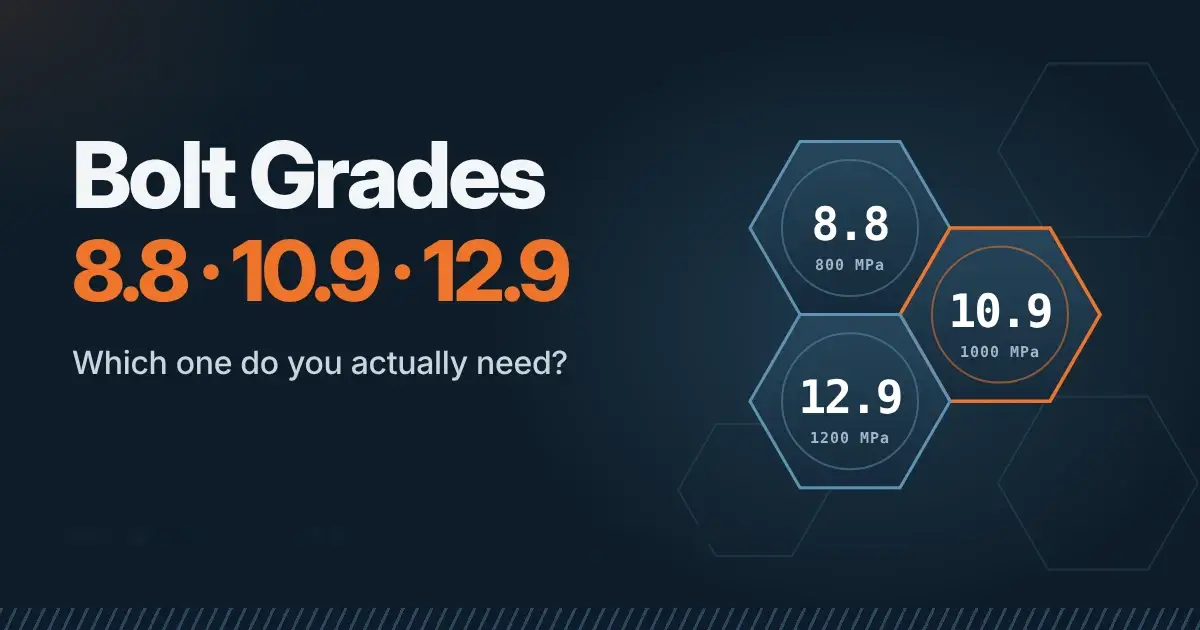
- 8.8 → 8 × 100 = 800 MPa
- 10.9 → 10 × 100 = 1000 MPa
- 12.9 → 12 × 100 = 1200 MPa
The second number is the yield ratio. It shows what fraction of that strength the bolt can take before it stretches permanently. A “9” means 90 percent, an “8” means 80 percent. So the nominal yield strengths are:
- 8.8 → 800 × 0.8 = 640 MPa
- 10.9 → 1000 × 0.9 = 900 MPa
- 12.9 → 1200 × 0.9 = 1080 MPa
Yield matters more than tensile in practice. A bolt that has yielded has stretched and lost its grip, so yield tells you how much clamping force you can safely build into a joint.
A small note for the careful reader: the standard lists minimum values slightly different from these round nominal figures (for example, 1040 MPa minimum tensile for 10.9 and 1220 MPa for 12.9). The nominal calculation is the easy way to compare grades. Your drawing will quote exact figures.
Grade 8.8 vs 10.9 vs 12.9 at a glance
← Swipe to see all grades →
| Property | Grade8.8 | Grade10.9 | Grade12.9 |
|---|---|---|---|
| Tensile strength | 800MPa | 1000MPa | 1200MPa |
| Yield strength | 640MPa | 900MPa | 1080MPa |
| Typical steel | Medium carbon, quenched and tempered | Medium carbon or alloy, quenched and tempered | Alloy steel, quenched and tempered |
| Matching nut | Class 8 | Class 10 | Class 12 |
| Typical uses | General construction, machinery | Automotive, heavy equipment, high-load joints | Precision machinery, tooling, compact assemblies |
| Forgiveness | Higher | Medium | Lower |
| Relative cost | Lowest | Medium | Highest |
Nominal values per ISO 898-1. Your drawing or specification will quote the exact minimums.
Looking for a reliable nut bolt manufacturer in India ?
How to choose the right grade
- Start with the load. Is it steady, shock-loaded or vibrating? Your drawing or design engineer should give the required class. If you are deciding yourself, begin with 8.8 and move up only if load or space demands it.
- Check the space. Where diameter is limited, a higher grade carries more load at the same size. Where you have room, a larger 8.8 is often cheaper and more forgiving than a smaller 12.9.
- Think about the environment. Outdoor, coastal, chemical or high-temperature conditions affect both material and coating.
- Consider how it will be tightened. Higher grades respond strongly to small torque errors. If your team tightens by spanner without torque control, 8.8 or 10.9 is the safer bet.
- Specify the whole assembly. Bolt, nut and washer together. Mixing grades is where good designs go wrong.
- Weigh the cost honestly. In bulk orders the price gap adds up. Paying for 12.9 where 10.9 would do wastes budget. Buying 8.8 where 10.9 is needed risks the joint.
Four common mistakes
Assuming a higher grade is always safer. A stronger bolt in the wrong place can be more dangerous, because it may fail suddenly and be harder to tighten correctly.
Mixing bolt and nut grades. The joint is only as strong as its weakest part.
Reusing high-grade bolts endlessly. A bolt tightened close to yield has already stretched a little. For critical joints, follow the designer’s reuse guidance rather than a guess.
Buying on price alone. Two bolts stamped 10.9 can behave very differently if one was made with poor steel or poorly controlled heat treatment. The marking is a claim. Test certificates and a trustworthy manufacturer back it up. Look for the property class and the maker’s mark on the head, and treat unmarked high tensile bolts with suspicion.
Choosing a manufacturer you can rely on
India is one of the world’s major fastener producers, and Ludhiana has long been among its busiest engineering centres. Buying factory direct from a Ludhiana manufacturer can mean better pricing, flexible bulk quantities and quicker dispatch across the country.
JVS Nut Bolt, a brand of Oxford International, manufactures high tensile bolts, nuts, washers and threaded rods from Ludhiana, Punjab. We are ISO 9001:2015 certified with more than 45 years of manufacturing experience, supplying construction, automotive, railways and infrastructure, steel fabrication, solar and heavy engineering across India.
Not sure which grade your project needs? Share your drawing or a rough description of the application and our team will help you choose. Browse the range:
FAQs
It is the bolt's property class. The first 8 means a nominal tensile strength of 800 MPa. The second 8 means the bolt yields at 80 percent of that, which is 640 MPa.
A 10.9 bolt has a nominal tensile strength of 1000 MPa against 800 MPa, and a nominal yield of 900 MPa against 640 MPa. It is stronger and better for high preload, but costs more and needs more care with coatings.
It is stronger, not better for every job. A 12.9 bolt is less forgiving when overloaded and more sensitive to hydrogen embrittlement, so 10.9 is often the more sensible choice.
No. Pair a 10.9 bolt with a class 10 nut and a 12.9 bolt with a class 12 nut. A nut of equal or higher class is safe.
Bolts made from heat-treated steel that carry much higher loads than mild steel bolts. In common industrial use, grades from 8.8 upwards count as high tensile.
Only with caution. Higher strength bolts are more prone to hydrogen embrittlement, so plating and galvanizing must be tightly controlled or avoided. Discuss grade and environment with your manufacturer first.
Looking for a reliable Nut bolt manufacturer in India or a trusted industrial fasteners supplier in India?
Choose JVS Nut Bolt for premium-quality industrial fasteners, advanced manufacturing, competitive pricing, and trusted fastening solutions for industrial applications.
- Bulk Orders
- Industrial Fasteners Supply
- Custom Manufacturing Solutions
- High Tensile Fasteners
JVS Nut Bolt — Precision. Strength. Reliability.
👉 Still have questions?
Contact us directly—we’ll help you quickly.